Community pharmacies: A new frontier for PrEP access
12 February 2026
Community pharmacies are a “promising site” for expanding access to HIV Pre-Exposure Prophylaxis (PrEP), according to a recent pilot study led by researchers at NIHR ARC West and NIHR Health Protection Research Unit (HPRU) in Evaluation and Behavioural Science. Published in Sexually Transmitted Infections, the study suggests they are particularly promising for under-served groups who may not engage with traditional sexual health clinics.
PrEP is a highly effective medication that HIV-negative people can take to reduce their risk of getting HIV. In England, PrEP is provided free via NHS sexual health clinics. This model presents barriers, including geographic distance, limited appointments, and the stigma associated with visiting specialist sexual health centres.
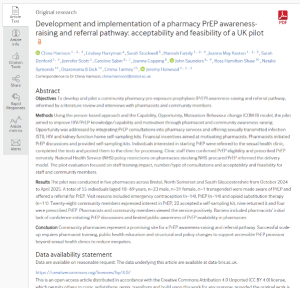
Accessing PrEP through Pharmacies to Improve HIV Prevention is the first study of its kind in the UK to design and pilot a novel PrEP awareness-raising and referral pathway. The pathway was implemented across five pharmacies in Bristol, North Somerset and South Gloucestershire (BNSSG). The intervention aimed to address persistent inequities in PrEP uptake among populations such as women, people who inject drugs and minoritised ethnic communities.
The pilot aimed to integrate PrEP discussions into routine pharmacy visits, such as those for emergency contraception or opioid substitution therapy.
Key findings
The evaluation, which ran from October 2024 to April 2025, revealed high acceptability among both staff and the public:
- Diverse reach: Of the 55 individuals who received a consultation, over half were female and a significant portion were people who inject drugs
- Training impact: Pharmacy staff knowledge scores nearly doubled following online and in-person training, rising from 4.77 to 9.10 out of 10
- Effective referrals: 28 community members expressed interest in PrEP, resulting in 22 referrals to local sexual health clinics for remote prescribing
- Anonymity and ease: Community members praised pharmacies for their accessibility and “anonymity,” noting they felt less intimidating than specialist clinics
“But when it’s the local chemist, it’s so accessible… no appointment needed, and you don’t have a long wait in a queue.” – Community member
Overcoming implementation barriers
Despite the positive feedback, the study highlighted several structural challenges that must be addressed for successful scale-up:
- Clinician confidence: Pharmacists initially felt “embarrassment or unease” regarding how to raise sexual health topics, though confidence grew with experience
- Pathways and kits: Only 32% of self-sampling kits provided were returned, suggesting a need for better in-person support for complex blood tests
- Policy restrictions: Current NHS policy prevents pharmacies from stocking NHS-procured PrEP, necessitating a complex referral-to-clinic model
The research team concludes that for pharmacies to become autonomous providers, policy changes are required to allow them to stock, supply and manage PrEP prescriptions directly. This would streamline the process and potentially include the new long-acting injectable PrEP formulations.
The researchers have produced a policy briefing, available via PolicyBristol: Pharmacy PrEP Delivery Briefing.
Dr China Harrison, Research Fellow at NIHR ARC West and lead author of the study, said:
“Our pilot has demonstrated that community pharmacies show a lot of promise as a site for accessing PrEP. With the right support and commissioning, they could play a critical role in reducing HIV transmission and addressing sexual health inequalities.”
Professor Jeremy Horwood, principal investigator of the study and researcher from University of Bristol:
“Our study shows that community pharmacies can play a vital role in widening access to HIV prevention. By equipping pharmacists with the right training, integrating home testing, and creating supportive pathways for PrEP initiation, we demonstrated that it is both feasible and acceptable to deliver PrEP in pharmacy settings.
“This model has the potential to reach people who may not engage with traditional sexual health services, helping reduce inequalities in HIV prevention and moving us closer to the goal of ending new HIV infections.”
This research was funded by Gilead Sciences, Inc and supported by NIHR ARC West, alongside two NIHR Health Protection Research Units (HPRUs) – the HPRU in Evaluation and Behavioural Science at the University of Bristol and the HPRU in Blood Borne and Sexually Transmitted Infections at UCL.
Paper