European stakeholders say 5G rollout in workplaces is “behind expectations”
1 December 2025
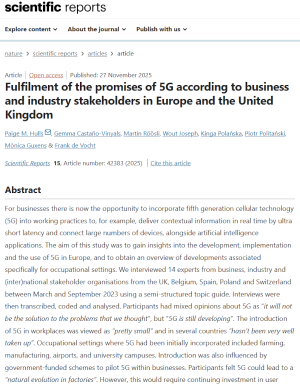
How business, industry and public-sector stakeholders across Europe perceive the development, implementation and early use of fifth-generation (5G) mobile networks is explored in a new GOLIAT project paper. The exploratory study, led by researchers from the University of Bristol including ARC West’s Professor Frank de Vocht, reveals the adoption of 5G in occupational settings remains limited and slower than initially envisioned.
Published in the journal Nature Scientific Reports, the study explores how 5G is being developed and used in Europe and offers insights into why its adoption in workplaces remains slower than initially anticipated. The team interviewed 14 experts from industry, including participants from telecommunications companies, government bodies, emergency services, electromagnetic-field consultancy and academia, from the UK, Belgium, Spain, Poland and Switzerland.
5G is expected to enable ultra-fast connectivity, low latency and real-time data processing, revolutionising sectors such as manufacturing, logistics, public safety and health care. Although implementation of 5G covers almost 90% of the European population, the interviewees reported that standalone 5G networks remain incompletely deployed and that business uptake is trailing expectations.
Limited 5G use in workplaces
Participants agreed that the current adoption of 5G in business environments “hasn’t been very well taken up”. Early uses are concentrated in manufacturing, farming, ports and airports, with the education sector showing increasing interest. Other areas identified as potential beneficiaries of 5G deployment include factories automating processes or emergency services, such as drones for rapid incident assessment.
Cost and equipment are main barriers
Within the barriers identified for the deployment in private businesses, the financial investment for the new equipment and resources needed to support 5G was mentioned as one of the major barriers, together with the lack of clear cost-benefit evidence.
Misinformation and COVID-19 impacted rollout
Stakeholders highlighted how conspiracy theories linking 5G and COVID-19 created public hostility which complicated deployment. The authors reference 100 arson attacks on 5G infrastructure “as a result of conspiracy theories”, including the burning of 77 mobile towers in the UK. At the same time, the pandemic also delayed access to hardware and slowed technical implementation.
Despite being marketed as a game-changing leap from 4G, experts said 5G has yet to deliver many of its promised capabilities. As one participant noted:
“5G will not be the solution to the problems that we thought five years ago.”
Paige M Hulls, researcher at the University of Bristol and lead author of the study, said:
“Given the complexity of the topic that has societal, environmental, engineering, and other impacts it is essential that future research takes an interdisciplinary approach. Future studies need to prioritise engaging with businesses, to understand their decision-making processes, and to explore why uptake has been lower than expected.”
Frank de Vocht, Professor at the University of Bristol and NIHR ARC West, and last author of the study, said:
“Future, more comprehensive, research would further benefit from inclusion of workers. Researchers should engage with employees working in 5G-implemented areas to ensure that any health concerns they may have regarding 5G exposure can be addressed.”
Paper